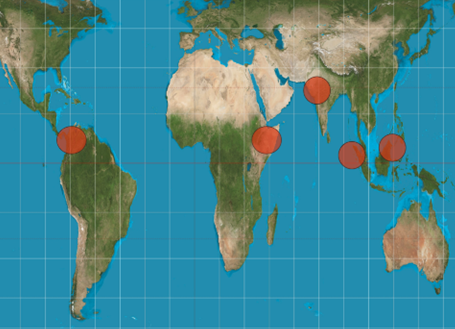
Resonar, Latin America – convened by Maytik Avirama (Indigenous feminist organiser, relational facilitator, and radio producer based in Colombia, working at the intersection of collective care, environmental activism, and healing justice) and Daniela Fontaine (supporter of processes with groups, individuals, and communities in spaces of listening and collective care in diverse contexts and territory based in Mexico).
‘What is this thing called care? How can we expand this notion of care? How do we support ourselves and the community? What are those small acts that have helped us get through each day? How can we turn self-care into a strategy for change? What does self-care mean in complex contexts, in contexts of caring for life, in contexts where everything is at stake? How can we cross-pollinate strategies between contexts?
‘We host groups of Latin American women activists, healers, and defenders of land and body. We are developing the care and defence of the ‘body-territory’, seeking to create solidarity and resonance between social movements going through similar situations across Latin America.’
fromtheroots, East Afrika – convened by Wangũi wa Kamonji (retriever and restorer of indigenous Afrikan lifeways and practices through research, dance, story and facilitating diverse public spaces for critical consciousness and transformation).
‘I host spaces and processes for rethinking and reimagining relationship with self, other, Earth, and ancestry grounded in Indigenous Afrikan ontologies. Hosting groups and nurturing apprentices, planting the seeds for reconnecting to and reimagining indigenous Afrikan knowledges and practices for regeneration.’
Born and based in Ongata Rongai, East Afrika, Wangũi wa Kamonji researches and translates indigenous Afrikan knowledges and more into experiential processes, art and honey to provide rooted embodied tools for us to decolonise and reindigenise. Her work is published on Decolonial Passage, Open Global Rights, Africa is a Country, Transition Network among others. She is also related to planetary networks such as the @EcoversitiesAlliance and the Global Tapestry of Alternatives (GTA).
Solidarity in Journalism, India and international – convened by Ankita Anand (award-winning independent journalist and editor, recipient of the European Commission’s Lorenzo Natali Media Prize, the Statesman Award for Rural Reporting, and the UNFPA-Laadli Media Award.)
‘Developing journalists’ knowledge and capacity for creating cultures of care and relationship across difference in service of solidarity within their own work, networks and communities feels ever more important. Enabling hyperlocal voices, people using minimal resources but immense courage to tell stories from within their own communities is my passion. Connecting these people, understanding their needs, and creating training opportunities so they can slow down, listen, and amplify voices of marginalised groups in solidary ways.
‘We learn that unless we are in touch with our own emotions and have ways to process them, we cannot provide a safe space for our interviewees to share with us their deeply personal stories. All who we work with are enabled to carry the work forward and share the learnings with their colleagues and communities.’
The Laudato Si’ Asia – Coalition for Culture of Care, Resilience and Ecological Justice (LSIA-CAREJ) – Asia and international has a Culture of Care Circle which is convened by Clare Westwood.
‘LSIA-CAREJ is a coalition of organizations and individuals dedicated to the mission of advancing ecological spirituality, resilience and ecological justice across Asia through a culture of care framework to build solidarity and a just and resilient Asia for all. Initiated by Catholics in Asia, it is open to people of all faiths and cultures.
‘We facilitate and host CULCARE programmes with participants from countries across Asia as well as for Asians living in other continents. In the process, we train facilitators to adopt and adapt what they learn to serve specific cohorts and local communities incorporating local cultures and languages. So far, we have trained facilitators from Malaysia, Hong Kong, India, the Philippines, Peru, and Myanmar.’
Building Communities of Practice, Borneo and South East Asia – convened by Cynthia Ong (facilitator of processes, partnerships and projects that provoke ecologically sustainable co-existence between groups, communities, regions and nations).
‘Our frame is that the crisis is relational – which means that we and our movements are often stuck in “fight-flight-freeze” states requiring us to shift the ways in which we respond: our way of being. Our work here is to co-learn practices which can help us build relational capacities and skills, and resource ourselves to engage more deeply and compassionately with others, sense alternatives to levels of ‘stuck’ and feel grounded while doing so.
‘We host multidimensional groups of regional folks who would benefit from resourcing in care and community in service to their work. We want to grow a community of practitioners and a constellation of co-conspirators that can access and transmit relational approaches in purposeful ways, including the mundane day-to-day. We do this in service of positively shifting the political ecology in the region to bring forward new forms of currency – such as responsibility, participation, reciprocity and trust – to achieve transition to a diversified, equitable, ecologically resilient circular economy.’